Updated: July 15, 2026 · Reading time: 8 minutes

Daniel works on battery-pack selection, charger matching and export documentation for cordless product programs.
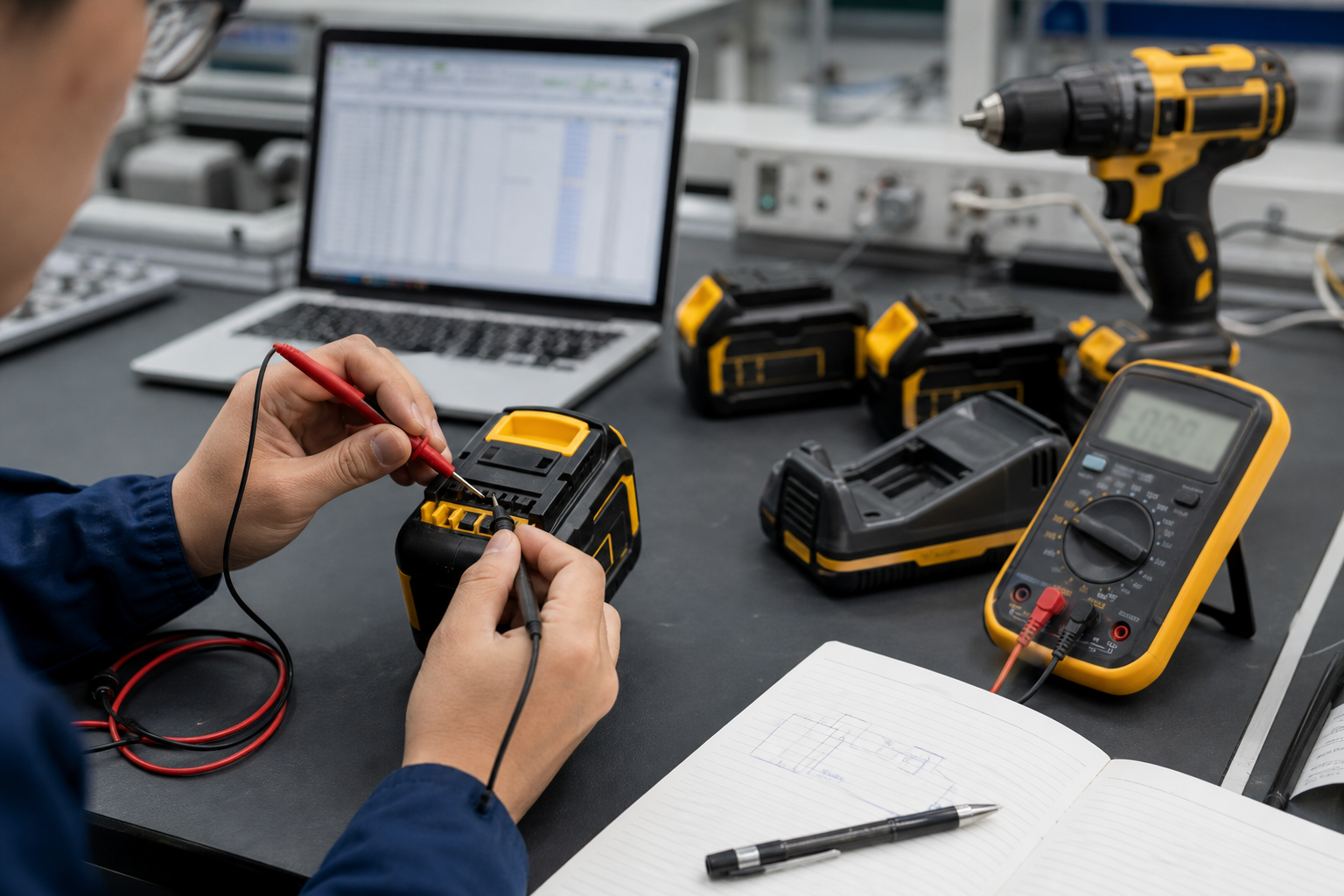
Use this calculator to compare battery-pack options before you quote a cordless tool kit. It gives a planning estimate, not a laboratory guarantee. Actual runtime changes with tool load, motor efficiency, material resistance, user behavior and battery temperature.
Calculate battery watt-hours and estimated runtime
Multiply voltage by amp-hours, then divide by the tool's average power draw to estimate runtime.
For a first kit plan, the number you need is watt-hours. A 20V 5.0Ah pack contains roughly 100Wh of nominal energy. If a tool draws an average 180W under the intended task, that pack provides a planning estimate of about 33 minutes of continuous loaded runtime. In a real working day, a drill is not held at full load continuously, so the usable job time can be much longer.
How to read the formula without overpromising
Watt-hours describe stored energy; runtime depends on how hard the tool works.
Watt-hours = voltage × amp-hours. A 20V 2.0Ah pack is roughly 40Wh, a 20V 4.0Ah pack is roughly 80Wh, and a 20V 5.0Ah pack is roughly 100Wh. The calculator divides that energy by an average load. It is useful for comparing kits, but it should not be turned into a blanket marketing claim such as "runs for 60 minutes" without a defined test method.
For example, a drill may need only modest energy while driving small screws into softwood. The same drill can draw far more current when drilling large holes in dense material. An angle grinder cutting steel is more demanding again. A better supplier conversation names the tool, material, accessory, duty cycle and target runtime instead of asking only for "the biggest battery."
| Planning input | What it changes | What to confirm before launch |
|---|---|---|
| Voltage | Sets the platform and pack family | Battery compatibility across every first-launch tool |
| Amp-hours | Changes stored energy, kit weight and shelf price | Which capacity belongs in the base kit and which is the upgrade |
| Tool load | Changes actual runtime far more than a label suggests | Test material, accessory, duty cycle and heat behavior |
| Charger route | Changes user experience and market fit | Charge time, plug, input label, safety scope and carton content |
Choose the pack by buyer and use case
Use 2.0Ah for entry kits, 4.0Ah for the core range and 5.0Ah for higher-duty upgrades.
A 2.0Ah pack keeps a drill kit lighter and more accessible for DIY shelves. A 4.0Ah pack is often the most balanced option for professional retail because it gives noticeably more runtime without turning a compact drill into a heavy product. A 5.0Ah pack makes sense when the buyer uses a brushless tool, an angle grinder or a long-duration work pattern where the user can feel the difference.
| Battery pack | Nominal energy | Typical kit role | Natural next link |
|---|---|---|---|
| 20V 2.0Ah | 40Wh | Entry drill and value retail kit | Cordless drill |
| 20V 4.0Ah | 80Wh | Core drill/driver and professional retail kit | Impact driver |
| 20V 5.0Ah | 100Wh | Trade kit and higher-load tool bundle | Angle grinder |
| 40V 4.0Ah | 160Wh | Higher-output and outdoor-power extension | 20V vs 40V guide |
Validate the estimate with a real runtime test
Use the calculator to choose candidates, then test each candidate under the task the buyer will actually perform.
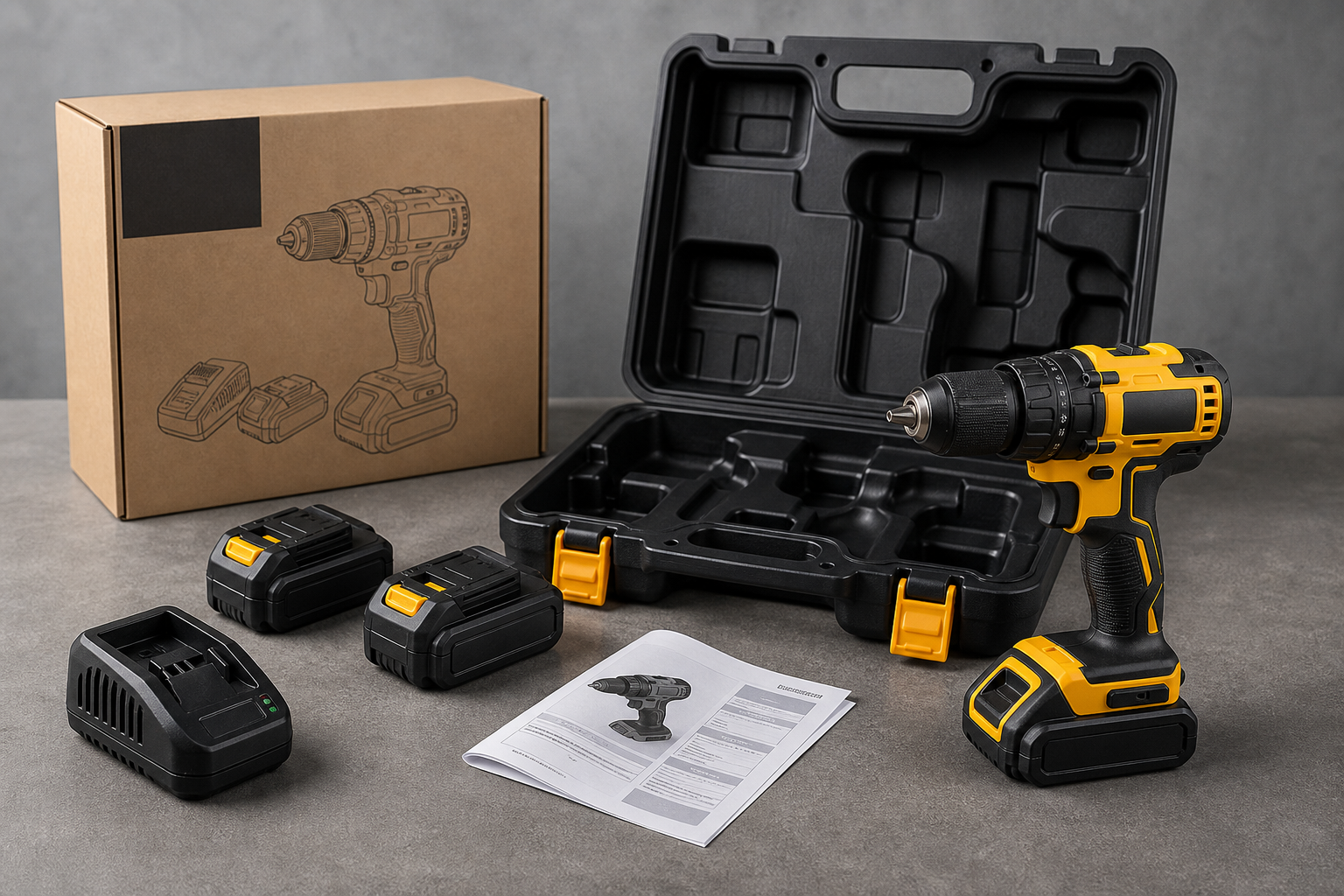
Before sample approval, agree on a basic test plan. It can be simple: same tool, same battery, same accessory, same material and the same defined working cycle. Record run time, battery temperature, tool temperature and the point at which protection cuts in. This creates a useful comparison between 2.0Ah, 4.0Ah and 5.0Ah kits without pretending that every customer will use the tool in exactly the same way.
- Define the application: screwdriving, drilling, grinding or cutting.
- Keep the material and accessory constant across the battery comparison.
- Record continuous loaded time and practical work cycles separately.
- Check heat, charger behavior and battery-protection response.
- Turn the result into a product-page proof point only after the test is repeatable.
How should a runtime claim appear on a product page?
State the battery, tool, task and test condition together so a buyer knows what the runtime number actually means.
A useful claim sounds like this: "20V 4.0Ah pack tested on the listed impact driver in a defined fastening cycle." It does not need to make the number sound dramatic. It needs to make the test understandable. Name the model, pack capacity, accessory, material and working cycle. If the task includes pauses, state that it is an intermittent-use result. If the figure is a continuous-load test, say so clearly.
This discipline protects both the buyer and the supplier. The marketing team can show a real decision point rather than a vague promise, while the sales team can answer follow-up questions with the same test conditions. It also makes comparison fair: a 2.0Ah and 4.0Ah pack can be judged on the same tool and task instead of being compared through unrelated claims. Link the result to the exact tool model and the battery test route so the proof remains easy to trace.

Use the result in your RFQ, not only in a spreadsheet
Put the intended runtime, price band and user into the RFQ so the factory can recommend a complete kit.
Send the tool list, target retail price, expected buyer, destination market and desired runtime to the supplier. Then ask for the battery capacity, charger type, cell route, BMS protection, pack weight, transport document route and MOQ that match the plan. This avoids a common mistake: quoting a large battery because it looks impressive, then discovering it makes the kit too expensive, too heavy or unsuitable for the target shelf.
For the broader platform decision, read the 20V vs 40V platform guide. For the detailed pack components, read how to choose a cordless tool battery. Together, the three pages form one decision path rather than three disconnected pieces of content.
Frequently asked questions
These answers help buyers interpret the calculation before they choose a pack for a commercial kit.
How is battery runtime calculated?
Multiply voltage by amp-hours, then divide the result by average power draw. The result is an estimate because tool load, temperature and motor efficiency change in real work.
Is the largest battery always best?
No. A larger pack adds runtime, weight and cost at the same time. Match capacity to the main tool and the buyer's price band rather than making every kit as large as possible.
Why does the same pack run differently on two tools?
Different tools pull different power under load. A drill used lightly and a grinder cutting steel can produce very different runtime from the same 20V 5.0Ah battery.
What should an importer confirm before selecting a battery?
Confirm the use case, runtime target, cell route, BMS, charger and document scope. Those details protect the product, the buyer experience and the export route together.
Continue planning the range
Move from this runtime estimate to the platform, battery and product decisions that determine the whole range.
Need help choosing a battery configuration?
Send your tool list, target retail price and expected user. We will recommend a battery, charger and bundle structure for the launch.